The median price in Tuxedo Park will tell you what a house cost. It will not tell you what it took to close. In a village of roughly 330 houses set inside 2,086 acres and listed in its entirety on the National Register of Historic Places since March 13, 1980, the single most consequential document at the closing table is often not the appraisal or the inspection report. It is a folder from the Village Office on Lorillard Road documenting whether prior exterior work was approved by the Board of Architectural Review.
Buyers coming from Manhattan, Bergen County, or the wider Hudson Valley tend to arrive with a mental model of due diligence built for jurisdictions where a building permit is the ceiling of municipal interest. Tuxedo Park is not that jurisdiction. The BAR reaches further into a property than any board most second-home buyers have encountered, and the friction it creates is where a slow, thin market becomes a re-traded price.
"Projects which would alter the external visual elements of a land parcel, lot, structure or building shall require the approval of the Board of Architectural Review prior to the issuance of a Building Permit." — §100-31, Village Code
What "External Visual" Actually Covers
Read at face value, that sentence sounds like a rule about facades. In practice, the Village Building Department applies it to a much wider set of decisions a homeowner might not think to disclose:
- Landscaping changes and the removal or topping of live trees over five inches in diameter, particularly within the Gateway Overlay setback along Tuxedo Road and South Gate Road
- Stone walls, fences, gates, and driveway apron work
- Accessory structures including cabana sheds, gazebos, greenhouses, follies, animal shelters, and playhouses, all named specifically in the Board's jurisdiction
- Exterior lighting installations and alterations
- Significant interior electrical upgrades, which the Building Department page flags as potentially subject to BAR, Planning Board, or Zoning Board review depending on scope
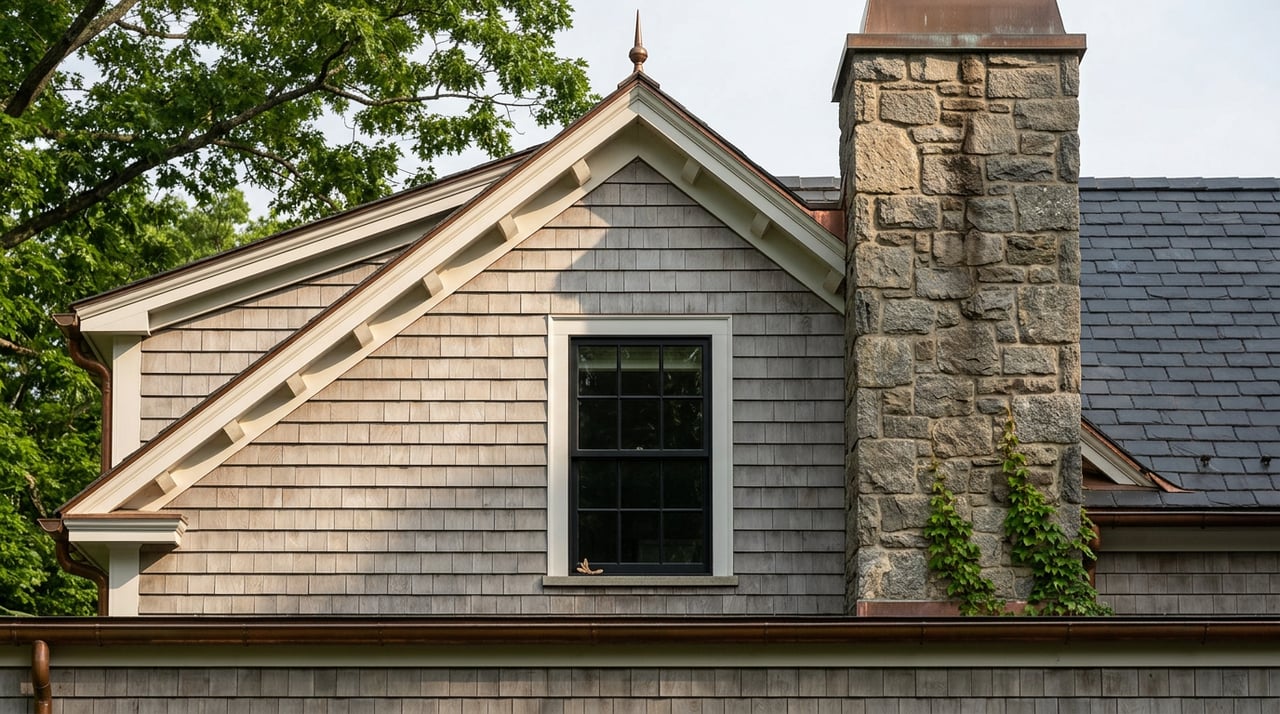
- Roof geometry, dormers, gables, window design and recess, doorways, rails, porches, gutters, eaves, louvers, garage doors, pillars, and sills, each named in the review criteria
The Village's own Building Department page puts this plainly: in keeping with the National Register listing, all changes to the property including landscaping, tree removal, stone walls and fences, built structures, and interiors that involve significant electrical upgrades may require approvals beyond a standard building permit. Routine repairs and maintenance are exempt only when they do not alter design, structure, materials, or appearance. Repainting in a different color is not routine. Replacing wood windows with a different profile is not routine.
The consequence for a seller is that a decade of small, well-intentioned improvements can quietly accumulate into a diligence problem. A buyer's attorney requests certificates of occupancy or completion; the Village record shows a gap; the negotiation reopens.
The Timeline Is the Deal Point
The second thing sellers underestimate is how the BAR calendar interacts with a contract date. The Board meets twice a month, on the first and third Mondays at 5:30 p.m. In the summer of 2026, that calendar runs July 6, July 20, August 3, August 17, and September 7, all confirmed on the Village events page. Every applicant begins on an informal work session agenda before advancing to a formal application, and once a formal application is filed, the Building Inspector has forty-five days to review it for conformance with the Village Code, the Uniform Fire Prevention and Building Code, and applicable water and sewer regulations.
After that review, the Board renders its decision within three formal meetings following the first agenda listing. Approval requires a motion, a second, and three affirmative votes on a five-member board. The applicant must submit postage sufficient to notify every property owner within five hundred feet of the subject parcel at least fourteen days before the meeting. Representation by a New York State registered architect or licensed professional engineer is required, waivable only when the project's total value falls below ten thousand dollars.
Layer those requirements against a purchase agreement and the arithmetic becomes concrete. A buyer who wants to close in sixty days and then repaint the trim, install a generator, and remove three dying oaks is not looking at a permit calendar. They are looking at a two-meeting minimum, a mailing, an architect's fee, and a Building Inspector review that can absorb a month and a half on its own. Any listing agent who lets a buyer walk into that discovery on the day of the walk-through has surrendered the closing.
Where Unpermitted Work Surfaces
The Village's Board of Architectural Review meeting minutes are public, and they read the way sellers should be reading them. The February 2, 2023 session, for example, saw the Board work through a 36 East Lake Road application involving pool, garage, patio, and entranceway changes, with detailed direction on stucco method (hand-troweled STO on a mesh system, no EIFS), color palette selection, and window sourcing from OTIIMA. A separate application at 2 Stable Road involved a partially installed fence for which the Board proposed redesigns to the newels and horizontal slats, plus screening plantings of boxwood and native vines.
Those are not abstract discussions. They are the exact level of detail a diligent buyer's counsel will later use to test whether the visible improvements on a property match anything in the Village file. If the file is quiet on a stucco recolor, a new fence, or a set of replaced windows, the buyer has leverage. In a market where the average sale in 2025 closed at 91.5 percent of asking over 140 days on market, according to Tuxedo Hudson Realty's own year-end review of the seventeen village transactions recorded, that leverage tends to be exercised in dollars, not walked away from.
The 2024 comparison is instructive. The same seventeen-sale count closed at an average of 95 percent of ask over 126 days. Between one year and the next, sellers gave up roughly three and a half points of pricing power and two additional weeks of exposure. A pre-listing audit against the Village file is one of the few unilateral moves a seller has to close that gap.
A Sequence That Protects Price
A seller anticipating a spring or fall listing in Tuxedo Park can front-load most of the BAR risk with a short, disciplined sequence:
- Request the full property file from the Village Office at 80 Lorillard Road before the listing photographer arrives. Building Inspector John Ledwith and the Clerk's office maintain records of every issued permit and BAR approval.
- Walk the exterior with the file in hand and identify any alteration that post-dates the last approval, including plantings replaced, trees removed, walls rebuilt, lighting installed, and windows or doors swapped.
- For anything undocumented, decide before listing whether to seek retroactive BAR review, price the exposure into the ask, or disclose and let the buyer weigh it during diligence rather than at the eleventh hour.
- If a renovation-minded buyer is the likely audience, request an informal work session on their behalf during the contract period so the buyer walks into closing with a Board conversation already begun.
- For properties in the Gateway Overlay along Tuxedo Road or South Gate Road, or for parcels with foundations at or above 800 feet east of the three lakes or 900 feet west, flag the Village Engineer's water pressure opinion requirement early. That single letter has delayed permits on hilltop parcels before.
What Buyers Should Actually Ask
The village is not an HOA. It is a New York State incorporated village within the Town of Tuxedo, and the landscape framework was designed by Ernest Bowditch, a contemporary of Frederick Law Olmsted. That distinction matters at the closing table because HOAs approve or deny; a village enforces through its Building Inspector, its Board of Trustees, and the Justice Court. A buyer with renovation ambitions should ask three specific questions before signing.
FAQ
Can I close and then apply for BAR approval on my renovation? You can close on the existing house. You cannot begin work that alters external visual elements, landscaping, or significant interior electrical systems until the BAR has approved the project and the Board of Trustees has issued the Building Permit that follows. Sequencing a work session during the contract period is the practical answer.
Do I need an architect to apply? Yes, in almost every case. Applications require a New York State registered architect or licensed professional engineer familiar with the site, SEQRA requirements, neighboring properties, the Zoning Law, and the Village's National Register designation. The Board may waive that requirement only for projects valued below ten thousand dollars.
How long is a Building Permit valid once issued? Eighteen months, with up to two six-month renewals available, capped at thirty continuous months. Work not completed by then requires new applications and new fees, and each reviewing board revisits the file to check for changes in the surrounding area.
What triggers a full new BAR application versus a routine repair? Any project that alters design, structure, materials, or appearance triggers Board review. Repainting in the existing color, replacing a shingle course in kind, or servicing a mechanical system does not. The Building Inspector is the correct first call whenever a homeowner is uncertain, and the Village explicitly advises that conversation.
The Village of Tuxedo Park does not sell despite its rules. It sells because of them. Every buyer who signs a contract here is buying into the reason the trees, the shorelines, the shingled rooflines, and the stone piers still look the way they did a century ago. Understanding the BAR before the offer is not a compliance exercise. It is the difference between a sale that closes at asking and one that reopens on a Tuesday two weeks before the walk-through.
If you are considering a listing in the village or preparing to purchase inside the gates, Tuxedo Hudson Realty offers concierge-level guidance through the Board's calendar and the Village file. Explore curated Hudson Valley estates.