If you are looking at luxury homes in Saddle River, architecture is not just a matter of taste. It shapes how a home lives, how it sits on the land, and often how it is valued. In a borough known for large estate parcels, long drives, and a strong sense of setting, style tells you a great deal about the property before you even step inside. This guide will help you read the architectural language of Saddle River luxury homes and understand what makes each style distinct. Let’s dive in.
Saddle River’s Estate Setting
Saddle River’s luxury identity begins with its physical pattern. This is not a compact luxury market built around dense streetscapes or attached housing. It is an estate-oriented borough where detached homes on generous parcels define the landscape.
That setting is tied to local history. The borough notes that the first house was built in 1709, that early families built Old Dutch homesteads from sandstone found in town, and that the minimum lot size was raised to two acres in 1951 to preserve the borough’s pastoral character. The borough master plan also describes the R-1 zone as a two-acre minimum district covering much of Saddle River.
The result is a market where land and architecture work together. In Saddle River, the approach to the house, the mature trees, the gates, and the sense of privacy are often just as important as the facade itself.
Historic Roots Still Shape Today’s Homes
Saddle River’s current luxury inventory may include newer construction and renovated estates, but the borough’s older architectural roots still matter. A 65-acre Saddle River Historic District was listed on the National Register in 1986, reinforcing the importance of preservation and historic context in the local landscape.
That history is visible in the borough’s early stone houses. The local record notes that early families used sandstone found in town, and a National Park Service survey of the Abram Ackerman House identifies coursed red sandstone walls as part of Bergen County’s early stone-house tradition. Even in newer luxury homes, that material legacy still influences how prestige is expressed.
For buyers and sellers, this matters because Saddle River luxury is rarely just about square footage. It is often about provenance, material quality, and how convincingly a home belongs to its setting.
Classic Colonials in Saddle River
Among the most visible luxury styles in Saddle River, the Colonial remains a defining presence. Current listings show several interpretations, including European-inspired Colonial estates, Georgian-inspired center-hall Colonials, and historic Dutch Colonial examples rooted in the borough’s earliest residential history.
What ties these homes together is structure and order. Many Colonial homes in Saddle River feature center-hall layouts, formal room sequences, and a clear distinction between entertaining spaces and everyday living areas. That organization gives the style a composed, traditional feel that continues to appeal to buyers who value symmetry and defined rooms.
What Colonial Floor Plans Often Offer
Colonial floor plans in Saddle River tend to be room-based rather than fully open. You may see a formal dining room, separate living spaces, guest suites, and a central circulation pattern that gives the house a clear sense of hierarchy.
For some buyers, this layout feels especially suited to formal entertaining or multi-generational living. It can also offer a strong balance between privacy and function, particularly in larger homes where each room has a distinct role.
Materials That Support the Look
Material choice plays a major role in how these homes present. In current examples, Colonial properties often lean on brick and red sandstone, materials that connect newer estates to older local building traditions.
These surfaces tend to reinforce a sense of permanence. In Saddle River, that can be an important part of a home’s identity, especially on a two-acre or larger parcel where the architecture needs to hold its own within a broad landscape.
Stone Manors and Estate Houses
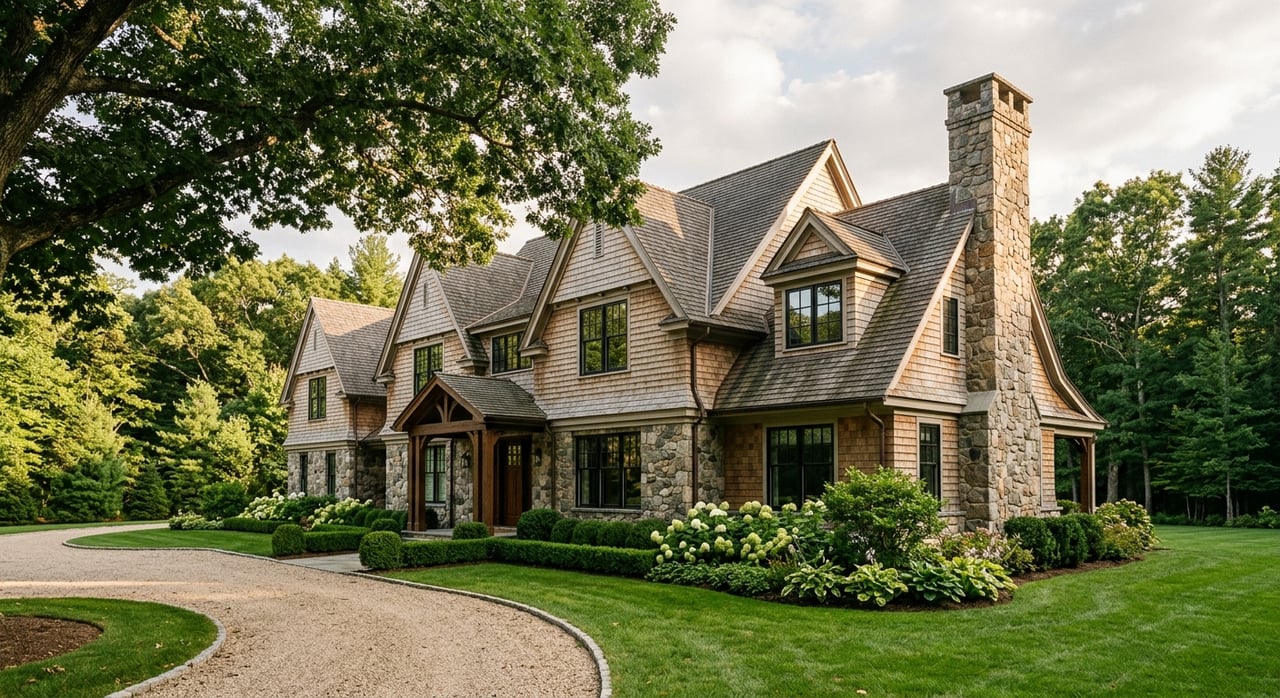
If the Colonial represents order, the stone manor often represents architectural pedigree and estate presence. This style family feels especially at home in Saddle River because it builds on the borough’s deep connection to masonry construction and substantial homes set back in the landscape.
Current listings describe stone-and-stucco manors behind gates and mature trees, all-brick manor homes on landscaped acreage, and architect-designed estates framed around provenance. These homes tend to read as layered and substantial, with architecture that announces itself through mass, material, and approach.
How Manor Homes Live
Manor-style homes in Saddle River are often more expansive in plan than traditional Colonials. Listings point to multiple sitting rooms, libraries or offices, solariums, full bars, and finished lower levels.
That kind of layout creates a different rhythm. Rather than a strict sequence of formal rooms, manor homes often feel like estates designed for both entertaining and retreat, with a variety of spaces that support gatherings, quiet work, and long weekends at home.
The Importance of Stone and Craft
Stone is central to this style’s appeal. In Saddle River, that choice carries extra meaning because of the borough’s early sandstone building tradition. Manor homes may combine stone, stucco, and brick on the exterior, while interiors often feature marble or limestone finishes that extend the sense of substance indoors.
For buyers, these materials can signal durability, craftsmanship, and architectural seriousness. For sellers, they can help position a home as more than simply large, especially when the design and condition support the story.
Contemporary Estates in Saddle River
Contemporary luxury homes in Saddle River bring a different kind of presence. Instead of relying on ornament or historic references, they tend to emphasize light, volume, and strong indoor-outdoor connections.
Current listings describe modern estates with walls of glass, terraces, covered patios, dramatic foyers, custom glass railings, state-of-the-art kitchens, and large sliding doors opening to outdoor living areas. In this segment of the market, the experience of space often matters as much as the exterior style.
Open Plans and Flow
Contemporary estates usually lean toward open layouts. Great rooms, broad kitchen-living connections, and direct access to terraces or pool areas are common features in current Saddle River listings.
If you prefer a home that feels visually open and easy to move through, this style may stand out. It often supports a more casual everyday lifestyle while still offering dramatic entertaining spaces.
Modern Materials and Finish
The material palette also shifts in contemporary homes. Listings highlight glass, porcelain, custom railings, and sleek finishes that create a cleaner and more current expression.
In Saddle River, these homes still depend on setting. Even the most modern estate gains much of its identity from acreage, privacy, and the relationship between the house and the surrounding grounds.
How Setting Defines Style
In Saddle River, architecture does not stop at the exterior wall. The site itself is part of the design, and that is one reason the borough reads differently from many other luxury markets.
Most premium homes are presented on parcels of two acres or more. Listings often highlight cul-de-sac placement, gated entries, mature-tree screening, and preserved views. One historic estate is even marketed with an additional parcel to maintain privacy and protect sightlines.
This means you are rarely evaluating style in isolation. A Georgian-inspired Colonial on a flat private parcel will feel different from a manor hidden behind gates, and both will feel different from a contemporary home whose walls of glass open toward terraces and landscape. In each case, the lot shapes the architecture’s success.
What Architecture Can Mean for Value
In Saddle River, the most useful way to think about value is through pedigree, privacy, and condition. That reading comes directly from how current luxury homes are marketed.
Some properties are positioned as new construction on private acreage. Others are presented as historically significant homes with named architects or as important estates ready to be restored and reimagined. In each case, architectural distinction becomes more meaningful when it is matched by a strong site, a workable floor plan, and careful stewardship potential.
For buyers, that means asking a few smart questions as you compare homes:
- Is the house a historic original or a newer revival interpretation?
- Is value driven mainly by the architecture, the land, or the property’s provenance?
- Does the floor plan favor formal entertaining, daily living, or a blend of both?
- Does the site feel like a true estate parcel or simply a larger suburban lot?
These questions can help you look past surface style and focus on what gives a property lasting appeal.
Which Style Fits Your Priorities?
The right style depends on how you want to live. If you are drawn to symmetry, tradition, and rooms with clear purpose, a Colonial may feel like the best fit. If you want architectural weight, layered interiors, and a stronger sense of estate drama, a stone manor may be more compelling.
If your priorities lean toward light, openness, and seamless outdoor access, a contemporary estate may offer the experience you want. In Saddle River, none of these choices is only aesthetic. Each one carries different implications for layout, materials, and the way the home meets the land.
That is why careful, place-based guidance matters. In a market where provenance and setting are part of the value, it helps to look at each property as a whole composition rather than a category label.
If you are considering a purchase or preparing to position an architecturally distinctive home for sale, working with a brokerage that understands design, landscape, and property narrative can make a meaningful difference. To explore estate properties with a thoughtful eye toward style, setting, and provenance, connect with Elizabeth Broderick.
FAQs
What architectural styles are most common in Saddle River luxury homes?
- The styles most visible in current Saddle River luxury listings are Classic Colonials, stone manors or estate houses, and contemporary estates.
How do Colonial homes in Saddle River usually differ from contemporary homes?
- Colonial homes in Saddle River tend to have center-hall layouts and more defined formal rooms, while contemporary homes usually emphasize open plans, great rooms, glass, and indoor-outdoor flow.
Why is stone so important in Saddle River luxury architecture?
- Stone matters because Saddle River’s early homes were built from local sandstone, and that material tradition still influences how luxury, permanence, and architectural pedigree are expressed today.
How does lot size affect luxury home style in Saddle River?
- Lot size is a major part of the architectural experience because many homes sit on two-acre or larger parcels, where privacy, approach, mature landscaping, and views shape the identity of the property.
What should you look at besides style when buying a Saddle River luxury home?
- Beyond style, it helps to evaluate the home’s condition, floor plan, privacy, site quality, and whether its value is tied more to architecture, land, or provenance.